

Team USA’s Ilona Maher is someone student-athletes aspire to be—and not just for her unshakable confidence and superstrong physique.
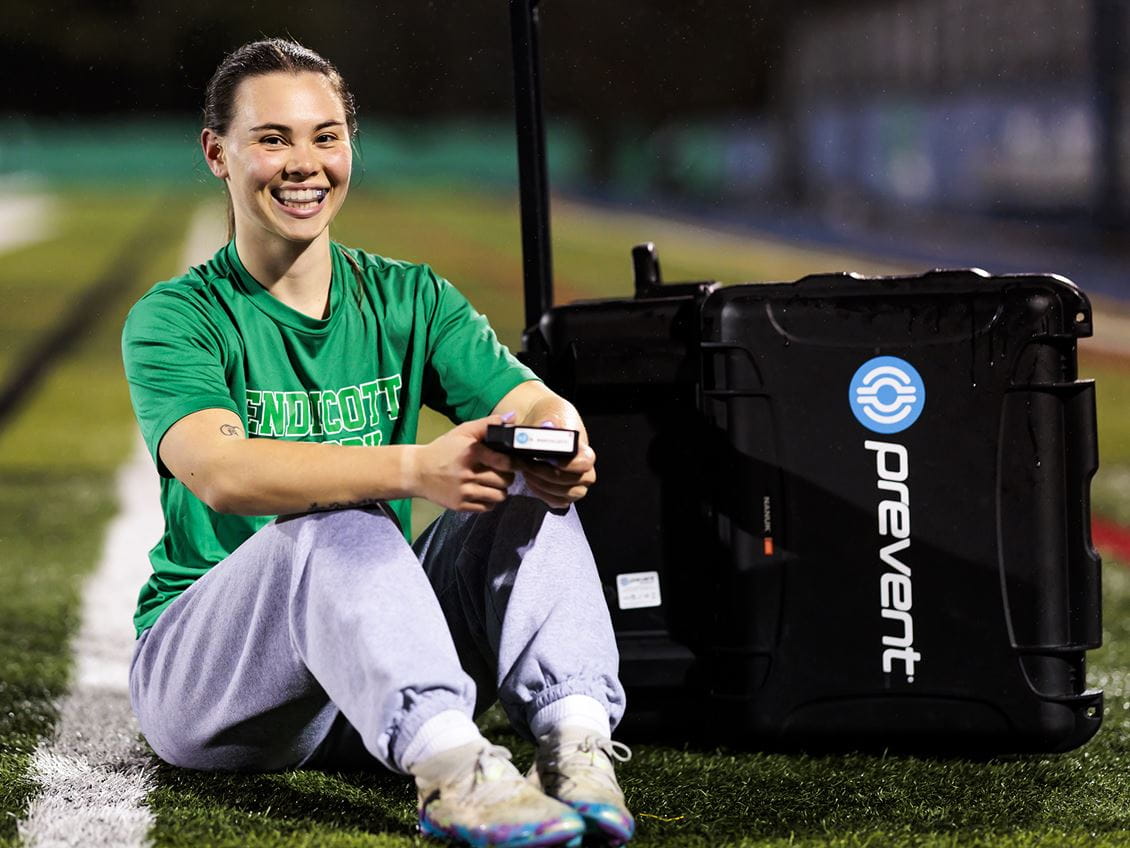
During the Women’s Rugby World Cup 2025, Maher made headlines for her fierce performance and for wearing a state-of-the-art mouthguard that lit up when she was hit too hard. Made by Prevent Biometrics, these mouthguards are designed to protect athletes in high-impact sports and are now being worn by the Endicott women’s rugby players, giving them a valuable experience and an edge in their sport.
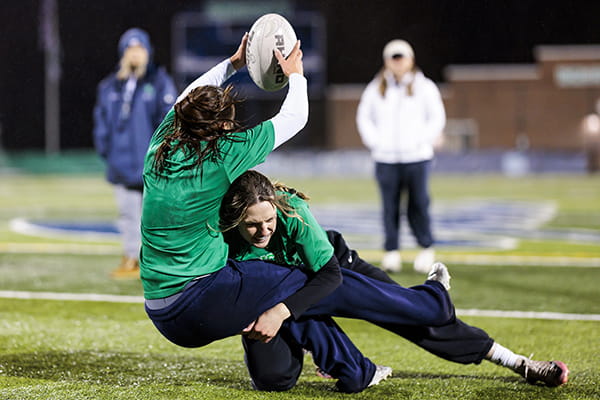
Paola Rivera, Assistant Professor of Exercise Science, secured this technology through the Provost Fund initiative and is using it to research how physical impacts affect performance and recovery. When looking for a team to collaborate with, rugby made the most sense, given the sport’s intense physicality and the fact that players don’t wear padding. It helped that she was already well acquainted with the rugby team’s head coach, Carly Baker, who’s also Assistant Director of the School of Sport Science, where Rivera teaches.
“This sport is very dynamic, high intensity,” Rivera said. “We ordered the mouthguards to monitor how many times someone gets hit and how hard they get hit. We later evaluate how recovered the player feels in comparison to the number of times they were hit.”
In addition to measuring impact, the mouthguards are equipped with accelerometers and gyroscopes to track exertion levels on the field, such as how fast a student-athlete is moving.
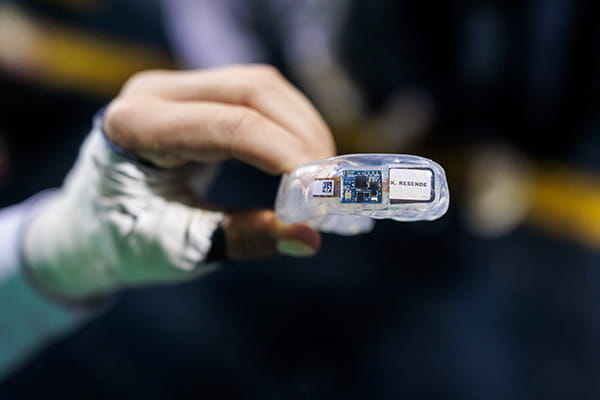
“It helps us determine why a player might not feel recovered, because we can see if they got hit a lot and put in a lot of effort,” Rivera said. “Looking at this data, we might tweak either their nutrition or recovery process or something about their next practice.”
Readings from the mouthguards are enhanced by data from lab tests. Over three visits, Rivera examines a player’s metabolic levels at different times and in different states—when they’re rested with “no practice or lifting session before” the visit, after practice, and after a match.
“When they come in, we can see roughly the number of calories they need if they didn’t practice that day and, conversely, that the calories they need are a little bit higher after a practice,” Rivera said. “We care about strength, and they need to fuel their bodies to be able to perform in these games and to recover afterward.”
Rivera also performs body composition tests to analyze water, muscle, and fat mass.
“The more muscle mass someone has, the better they can perform at their sport,” Rivera said. “But also, if someone has more muscle, they need more food to maintain those muscles. That really clicked with some of the girls.”
“Having more information as a coach, like having data to back up how many calories someone needs, how much protein someone needs, when they might need an ice bath, it sets us up for success,” said Baker.
The mouthguards have been enthusiastically welcomed by the women’s rugby team. Morgan Fischer ’28, an exercise science major, is disappointed to not be sporting the wearable technology.
She missed the initial fittings but is helping interpret mouthguard data generated by her teammates. “The big thing with using this technology is that we now definitely know when someone might be concussed. It gives you an extra level of precaution,” she said. “The data helps you learn so much about yourself as a player and also about your teammates and the environment you’re playing in.”
Alyssa Mellin ’26, also an exercise science major, said the mouthguards don’t impact her physicality in the slightest. She’s also been participating in Rivera’s testing and loves that Endicott is investing so much in its student-athletes.
“I just think the overall visibility of this will be so great for the women’s rugby program, the School of Sport Science, and for the college as a whole. These mouthguards are used by only a few people in the world. Now that we get to use them, it’s like we’re on the same level as elite athletes. That in itself is so cool,” Mellin said. “Endicott continuing to invest in us will allow us to continue to invest in ourselves.”
From a coaching standpoint, Baker couldn’t be more thrilled with the level of buy-in there’s been for the mouthguards. She acknowledges that this wearable technology can lead to scenarios in which someone might be pulled from a game—the last thing she or a player wants.
Baker noted, however, that the benefits of this technology far outweigh any drawbacks.
“This is a huge initiative for our program to have this technology, and it’s going to help us get to the next level,” said Baker. “We’re looking to go to nationals again. We’re hungry. We’re eager.”