

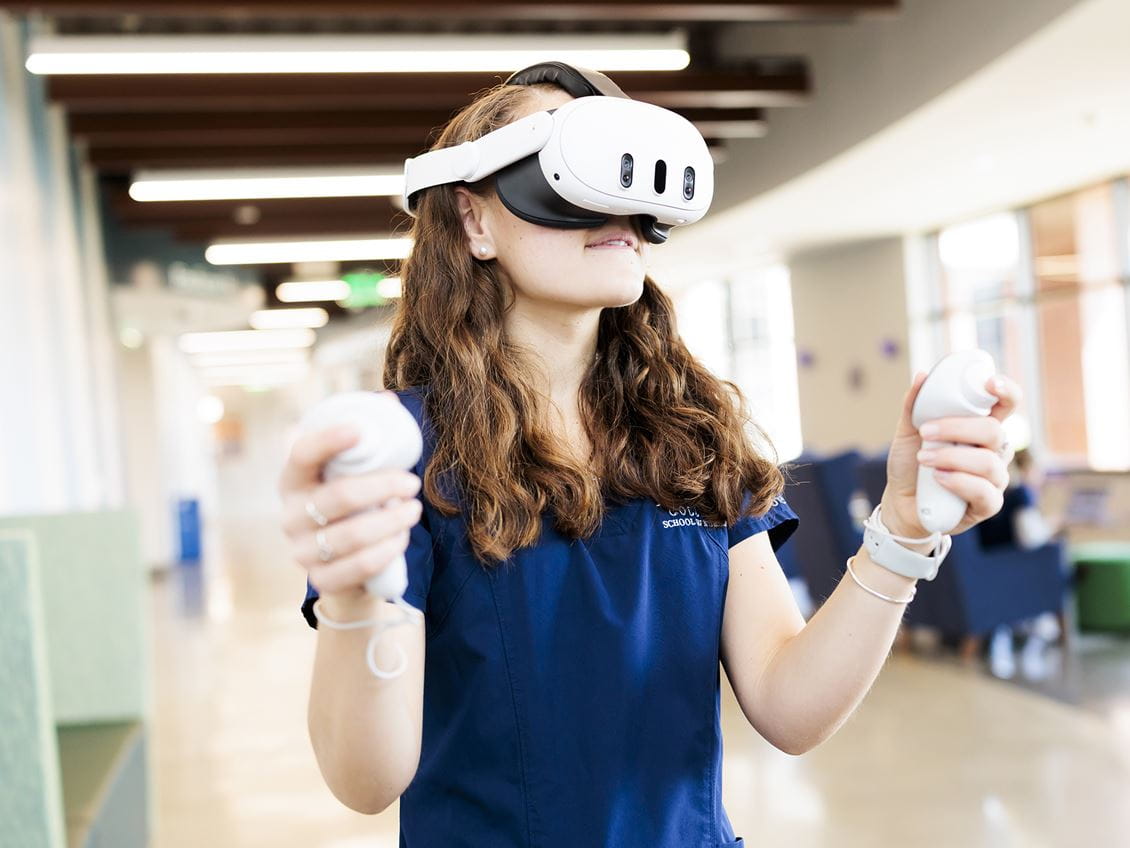
When nursing major Brooke Burke ’26 needed to take a break from the stresses of clinical rounds or even the demands of her schoolwork, she usually went for a run.
Now, thanks to the handiwork of Endicott Trustee Galen Ho, she can get a microburst of relaxation in between classes, or right before heading to work.
If you’ve taken a stroll around campus lately, you may have noticed the conspicuous VR wellness installations that now dot Lower Callahan, the Post Center, the Center for Belonging, and the Cummings School of Nursing & Health Sciences. These immersive stations are part of a pilot initiative developed by Ho and his company, ImmersiveWorlds, to help students—particularly those in high-stress healthcare programs—manage stress and combat burnout.
The idea for the installations was born from research into the growing crisis of burnout among nurses and healthcare professionals. National data underscore the urgency: 31.5% of nurses who left their jobs in 2017 cited burnout as the reason, and those working more than 40 hours per week were 3.28 times more likely to leave.
As a per diem support nurse tech, Burke often receives harder assignments. “After the shift, or even during the shift, I can tell I’m getting fatigued,” she said.
As a result, her capacity for compassion feels thin. To cope, she flips the script
“I have to reframe my mindset and tell myself, ‘This is a good opportunity for me,’” she said. “Because I am going to be a nurse, at the end of the day, this is just to make me more prepared.”
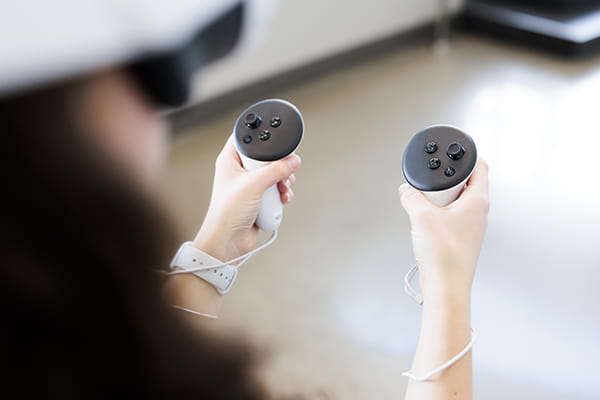
For Emily Carey ’26, who works in the cardiac ICU at Mass General Hospital, stress often comes with even higher stakes.
“It’s intense. It’s a lot,” Carey said. “You have some moments where you see people that were very, very sick, and they come back, and you see them walk for the first time, and it’s phenomenal. And then there are other times where the patient doesn’t make it.”
But, she added, “That’s where a really good team and where things like the VR headset come in. You need those supportive outlets to be able to manage all of that stress and burnout.”
Burnout has been linked to increased medical errors, diminished patient safety, and workforce shortages, which are exactly the challenges ImmersiveWorlds set out to address.
Users can select from multiple experience modes featuring calming settings such as forests, gardens, lakes, and oases. Guided meditation is available in certain modes, while others allow for silent reflection. According to Ho, the experience is intentionally brief—typically 10 to 15 minutes—making it ideal for students or healthcare professionals with limited downtime.
Endicott is uniquely positioned in this effort, Ho also noted. The initiative was specifically designed for the Cummings School of Nursing, with the College serving as the first pilot site for the technology.
The VR installations are also informed by insights gathered from Endicott students. A wellness survey conducted through the Center for Belonging found that nearly 50% of Gulls reported experiencing burnout often, with an additional 36.4% reporting it occasionally. Almost 90% of respondents reported trying mindfulness practices, such as meditation or breathing exercises, to manage stress. Many expressed interest in wellness topics such as managing stress, improving focus, and preventing burnout.
With finals on the way, the timing feels apt.
As Carey put it, having a place “to get away” can matter.
And for Burke, whose idea of wellness often begins on a morning run, the headsets offer another way to achieve what she called a “mental reset.”
Sometimes, that reset might be just what stressed Gulls need.