

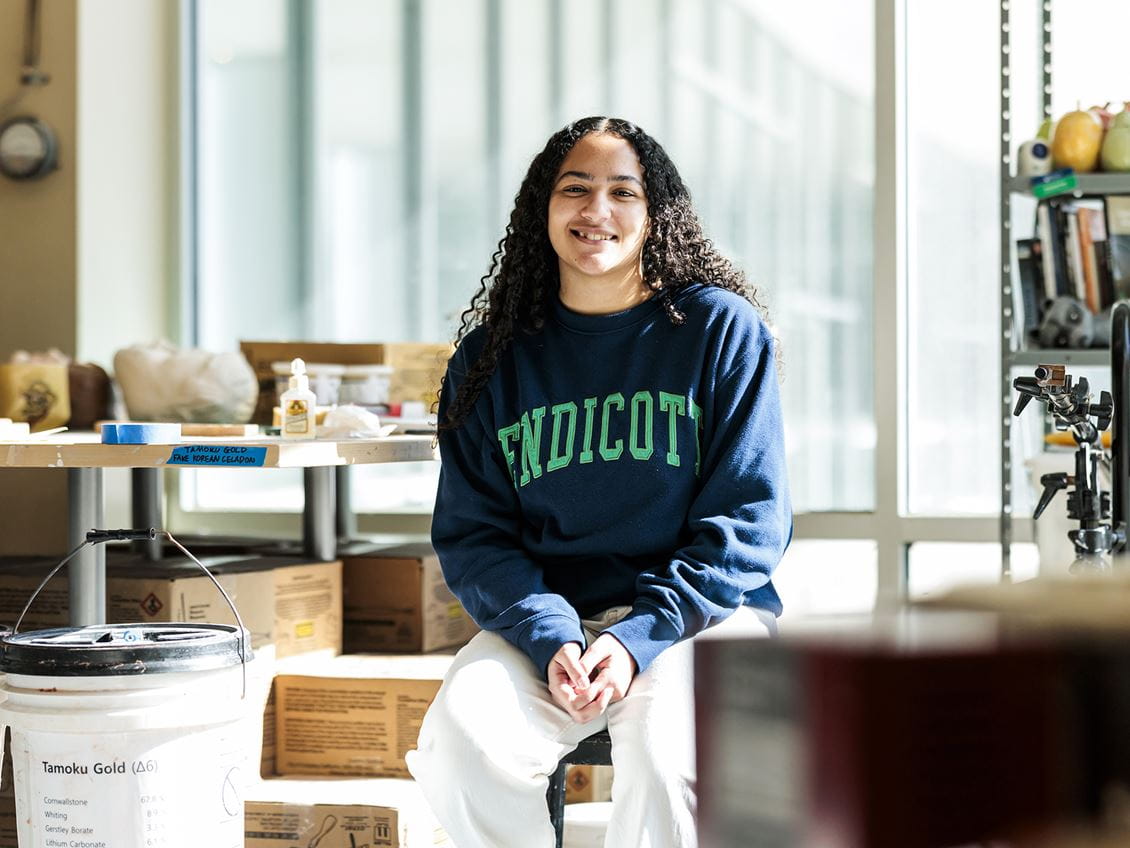
Sculptural ceramics, mixed media, photography, and oil painting. Veronique Campaz ’26 is well-versed in these and many other art forms. And as an art therapy major at Endicott, she’s been able to channel her prowess as an artist to help uplift others.
The youngest of three siblings and the only daughter, Campaz grew up in southern New Jersey and was always the “little artist of the family.” She cherished getting art kits as a kid, and in high school, when she started really coming into her own as an artist, her family would actually fight over her work. Everyone wanted to have an original Campaz piece in their home.
Campaz’s family taught her to appreciate fine art, exposing her early on to the work of great artists during trips to museums in New York City and Philadelphia. She feels lucky to have seen in person “The Starry Night” and some of the “Sunflowers” paintings by Vincent van Gogh. Given her field of study, it’s somewhat fitting that Campaz continues to be fascinated by van Gogh, who famously used art as a remedy for his neurological and psychological ailments.
“I’m passionate about art, and I’ve always wanted to help people, so putting those two things together is what really interests me,” Campaz said. “I’ve seen how much therapy can help people, and that’s a big thing that reinforced in me that I want to help people as well.”
At 16, Campaz experienced her own mental health crisis. She had just lost her father and began working with a therapist, who showed her just how beneficial talk therapy could be. “When I was in high school, when I was really going through it, I realized I wanted to be there for someone the way that I needed someone,” she said. “That’s really stuck with me.”
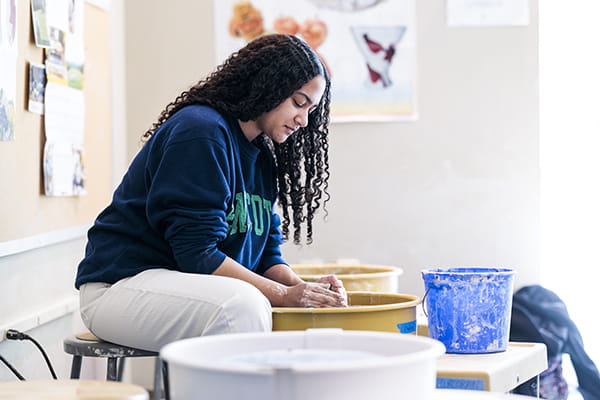
When considering colleges, Campaz knew she wanted to do something with art, but also wanted to follow a path that led to helping others. Endicott stood out with its art therapy major, which integrates the studies of studio art, psychology, and creative arts therapy. Campaz was already familiar with art therapy, having randomly read about it in middle school, and was excited about the fresh start studying at Endicott would provide.
“I chose a school so far away because I wanted to be away from everybody who knew me, so that I could truly figure out who I was outside of the preconceived notions of me,” Campaz said. “Through my time here at Endicott, I’ve definitely experienced a lot of interpersonal and professional growth.”
She attributes much of her professional growth to the Endicott Experiential Edge, the College’s pioneering internship program that connects students to top-tier study and work abroad opportunities. Through the program, Campaz had her first experience working in art therapy at Crawford Supported Studios in Cork, Ireland. Crawford provides disabled individuals with a safe studio space, quality art materials, and the mentorship of staffers trained in art therapy.
Campaz says a highlight of her time in Ireland was getting to see someone discover the peace that comes with painting. “There was one person who was nonverbal. She had a few hand cues to say what she wanted. During my time working with her, I definitely saw her get more communicative through the art she was making,” Campaz said. “She was originally a very, very fast painter, and we helped slow her down and got her to relax a little bit to where she would actually enjoy making her paintings.”
Another similarly rewarding experience happened during her most recent internship, at Raw Art Works in Lynn, Mass., a free after-school program for children in grades four through 12. There, Campaz offered support to a young girl who was experiencing bullying.
“She confided in me, and I was able to support her through that experience. I told her it’s important to learn how to speak up for yourself and that I would be there to support her,” Campaz said. The girl gained the courage to tell her parents and someone at school what was going on. “After that, I found out that she made more friends at school, and I’m glad I was able to help her stick up for herself and support her in the best way that I could.”
Campaz is a born leader who oozes with integrity and professionalism, according to her professors, and is one of a select number of 2025–26 Presidential Ambassadors, a cohort of Endicott students who well represent the mission and goals of the College and who collaborate with the College on various projects. She has a natural ability to uplift others, which was strengthened through her studies at Endicott. In particular, she’s learned through her coursework which art disciplines are best suited for specific mental health situations.
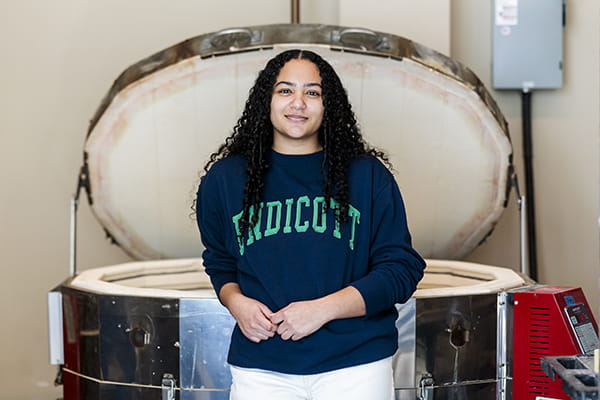
“If you’re working with a really anxious person, you wouldn’t right off the bat give them a marker or watercolor paints, things that they couldn’t erase,” Campaz said. “You would want to give them colored pencils or a pencil, so that they could control things a little bit. Then, as you form a closer bond, you can take away the control a bit more and more at a time, slowly introducing new materials, so they feel less anxious as time goes on.”
But in order to meet these moments, an art therapist needs to be at least a little skilled in most types of art. That’s where Endicott’s visual arts classes give Gulls an edge. Campaz specifically cites Advanced Art Studio, which she took during her junior year, as the class that has both been the most challenging and prepared her the most for a career in art therapy.
“You get that time to make 10 or more pieces of art—whatever you want. You use all the skills that you learned up until that point to make your own little gallery with your own theme,” she said. “Last year, my theme was on grief, and I think art really helps you express all that emotion. For me, at least, I feel a relief when I’m done making something. If there’s something heavy in your chest, as you’re working on the art, that heaviness slowly starts to fade away. And sometimes you can sort of see that grief or that emotion in the piece itself, almost like removing the pain from yourself and putting it into the art.”
Campaz has always felt that art-making might have bona fide therapeutic benefits, but as she looks toward graduation, she has seen that belief solidly validated. Art has not only helped her personally heal, but it’s also proved to be an empowering tool for those she’s worked with during her internships. Campaz is committed to becoming a registered art therapist and has already applied to several graduate programs.
“I have the next two years planned out. I got a summer job this year and hope to start graduate school in late August, and then I’ll spend the next couple of years learning to be certified,” she said. “In my internships, I learned a lot of the behind-the-scenes work for art therapy and got reassurance that this is something I want to do, that this is something that I want to be a part of.”