

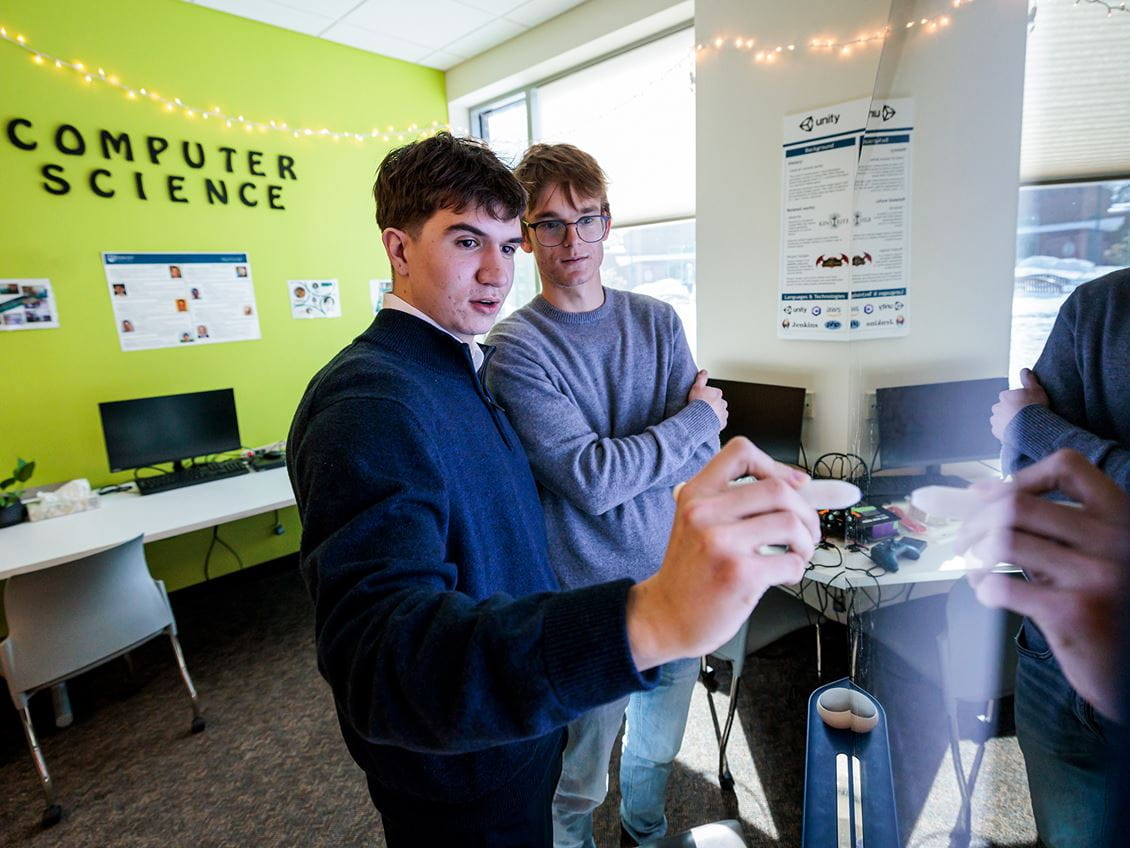
When it came time for computer science majors Conrad Kadel ’26 and Teo Berbic ’26 to secure senior internship sites last fall, they weren’t impressed with what they found. Having had traditional office experiences for their first two internships, they were interested in something new.
“We looked for internships, and we just saw there was nothing much we liked,” explained Kadel. “We wanted to be entrepreneurs; we always had the idea to start a business, so we looked at other solutions.”
Turns out, that solution was to take advantage of a growing opportunity through Endicott’s Experiential Edge—to use the College’s entrepreneurship supports to launch a startup during the semester set aside for the full-time senior internship.
Rather than traveling to a nearby company’s offices, they instead set up shop in the Gulls@Work space and spent the semester conducting market research, refining code, building a website, and learning everything necessary to launch their company, simplifyAi.
Mentored, Not Managed
Cher Harrington, Kadel and Berbic’s Site Supervisor, Internship Faculty, and Assistant Professor of Experiential Learning, explained that this type of opportunity offers a breadth difficult to find in a traditional internship.
“The whole purpose of the semester internship is to give students a path to be employable,” she said. “Now they can put on their resume how many clients they have, how they did their own marketing communications, all the logistics and the financials for their company—that’s huge.”
Students pursuing a startup internship must meet clear academic and professional expectations, including developing and presenting a viable business plan and demonstrating weekly progress throughout the semester.
“Students taking this route can’t have a half-baked idea,” cautioned Dr. Gina Deschamps, Chair of Entrepreneurship and Executive Director of the Colin and Erika Angle Center for Entrepreneurship, and the Faculty of Record for Kadel and Berbic’s venture. “They have to have proof of concept, to present a full business plan, to have a registered company name, LLC, bank account, and so forth.”
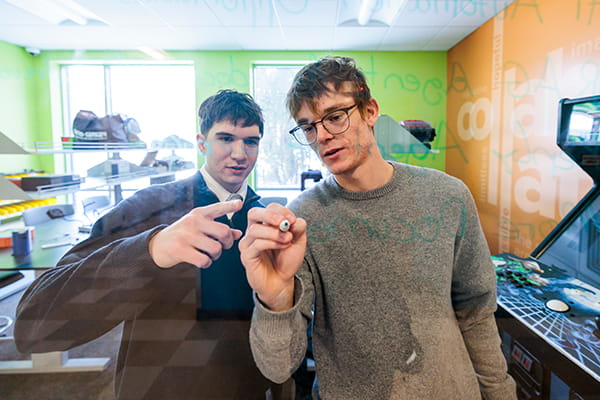
Over the semester, Kadel and Berbic met weekly with Harrington, who provided guidance, connected them with outside mentors—including her husband, who helped the pair navigate the long process of determining pricing for their product—and reviewed progress milestones to keep them on track. Deschamps linked Kadel and Berbic with networking opportunities at community events and gave suggestions when they felt stuck.
“At a traditional internship, you have someone who’s your mentor, and they give you work, and you check back in with them,” explained Berbic. “But this time, we were our own bosses, and we didn’t report to anyone except our partner.”
“We had to motivate each other,” added Kadel. “I think that’s a different type of learning experience.”
Putting AI to Work for Small Businesses
SimplifyAi builds customized AI agents designed to help small businesses automate repetitive tasks. Kadel and Berbic begin each project by meeting with clients to understand their specific challenges and design tailored systems that allow business owners to “focus on growing their business, not maintaining it.”
“We want workers to be able to focus on what they’re best at, not the administrative stuff,” said Kadel. “For instance, we talked to a real estate company, and its employees have to manually copy and paste the same information every Monday morning, so we’re trying to figure out an agent that can do that automatically for them.”
The venture has not been without challenges (though Kadel and Berbic insist the days that feel like failures are the ones when they learn the most). Tasked with overseeing all aspects of building a company, the pair sometimes struggled with additional responsibilities, such as marketing. They note that while their business minors were helpful to a certain extent, the real effectiveness comes from experience, which they had to create for themselves.
It was also sometimes a struggle to win over potential clients.
“We had a few pilot clients to start, just to get that trust,” shared Kadel. “It’s hard to convince people of the possibilities, because everything with AI technology is new, and people don’t really know how it works. Especially when we’re two college students.”
To help clients feel comfortable with their offerings, Kadel and Berbic started workshops for small businesses to teach them how to use AI effectively. They also built a dashboard that gives clients transparent access to settings for their own AI agents.
Clearing the Runway for Innovation
Internship opportunities like Kadel and Berbic’s are part of a wider Endicott trend to amplify startup support across the campus and community, as well as expand the limits of what required internships can be.
Next fall, the College will offer an INT480 class—the Friday classroom component that accompanies the Monday-Thursday senior internship—strictly for students pursuing the entrepreneurship path. Deschamps shared that Endicott is also working to relaunch the Gloucester campus as a startup and innovation hub available to the North Shore.
“I want Endicott to be positioned as the go-to resource for innovation,” she said. “We have the brain power here to help the community, and it makes the experience more real for our students.”

Deschamps also wants to see more students choosing the startup framework for their internship, and offered a reminder that every student on campus should consider it.
“Entrepreneurship isn’t relegated just to the School of Business, because it doesn’t work that way in the real world,” she explained. “I’m always trying to create intersections for students. I feel like it’s my job to clear the runway so that they can explore the possibilities.”
Beyond the Internship
Kadel and Berbic aren’t quite sure what happens to simplifyAi after graduation, especially since Kadel is from Germany and will likely need to return home. This semester, they’re juggling classes (and, in Kadel’s case, playing on the Gulls tennis team) with some bigger client projects that came through during the internship, and are keeping an open mind for the future.
“We haven’t thought of it too much, because we want to stay in the moment,” said Berbic. “As a software company, we can work remotely and have options. We want to see where we can take this.”
But for them, what they’ve accomplished so far is a point of pride, no matter what happens next.
It’s one for Deschamps, as well.
“I would not hesitate to put any of these students, regardless of their major, in front of external folks,” she said. “I’m really proud of everything they’re doing.”